





Cluster and Latent Class Analysis Software
Whether you want to use the familiar cluster analysis techniques, or state-of-the-art latent class analysis, it’s easy and efficient to do it in Displayr.
Trusted by 2,900+ research teams worldwide
Unlock data patterns with cluster & latent class analysis
All the key techniques
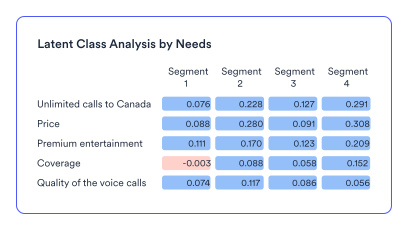
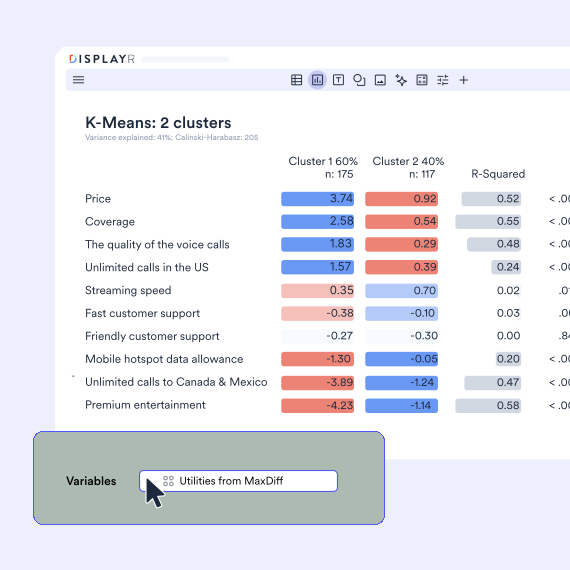
Hierarchical clustering, k-means clustering, latent class analysis, and all the associated techniques for predicting class membership in new data sets (e.g., regression, machine learning).
Deal with all data types
Displayr can be used to form segments with any type of data. Numeric. Categorical. Ranking. MaxDiff. Conjoint. Even text.
Fast to use
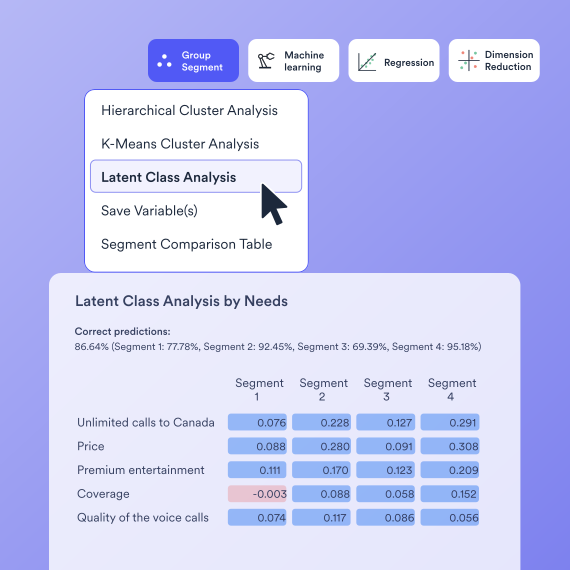
Drag and drop variables to create a cluster analysis and latent class analysis.
Missing data
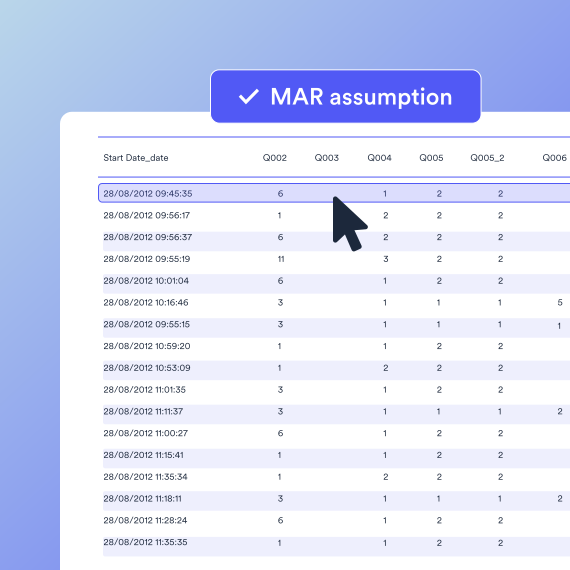
If you’re an expert you know that missing data can entirely derail cluster and latent class analysis, as the simple techniques, such as mean replacement, lead to the results being wrong. Displayr’s tools automatically deal with missing data problems using the best-practice MAR assumption, so you can focus on strategy and interpretation rather than trying to get the analysis working.
Efficiently profile and compare alternative analyses
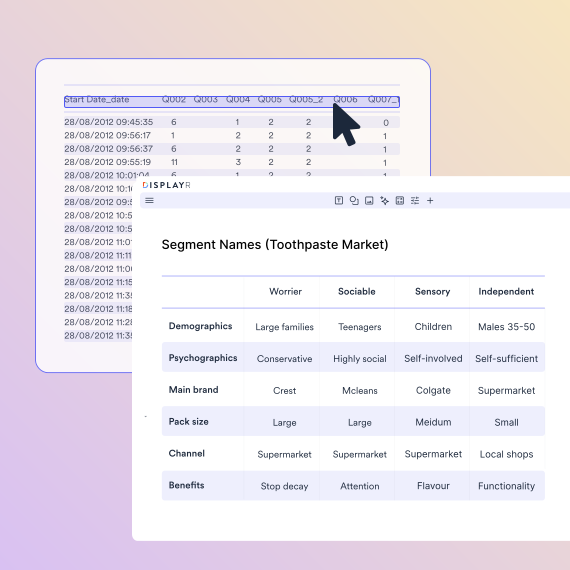
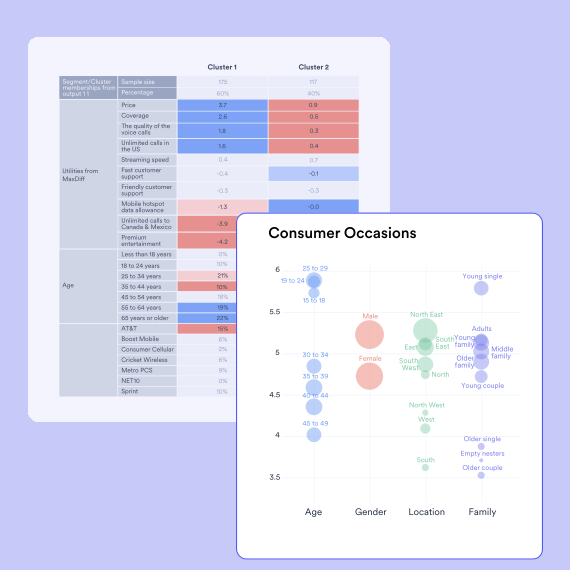
Displayr’s not just a clustering and latent class analysis tool. It is designed to do all your analysis and reporting. This makes it a snap to quickly profile and compare segments, whether you like to do this using crosstabs or some of our various visualizations designed specifically for comparing segments.

Vice President, Analytics, Leger
10x faster
cluster & latent class analysis
All types of data
SQL, databases, Excel, CSV, text, SPSS, survey platforms, APIs, integrations, & more.
All types of analysis
Summary tables, crosstabs, pivot tables, regression, text analysis, segmentation, machine learning, & more.
All types of reporting
Data visualization, interactive data apps, dashboards, presentations, PowerPoint, Excel, PDF, web pages, & more.

Integrated AI
Displayr’s Research Agents integrate AI across your full workflow, from data cleaning to analysis to reporting.
Case Study - MAC RESEARCH
Global Market Research Agency
Displayr helps MAC Research cut reporting and analysis time by 2/3rds
Challenges
- Standard survey tools lacking advanced dashboard capabilities
- Searching for cutting-edge dashboard and reporting technology
Solutions
- Dashboard solution that automates manual processes
- All-in-one software designed by market researchers
Results
- Cut reporting and analysis time by 2/3rds
- 5x business growth in two years
See why people love Displayr
Cluster & latent class analysis FAQs
What is Cluster Analysis?
Cluster Analysis is a statistical technique used to group similar data points together into groups called clusters. Clusters are distinct from one another, while the objects within each cluster are broadly similar. It is widely used in market segmentation, customer profiling, and pattern recognition.
What are the different methods of Cluster Analysis?
As Cluster Analysis is relatively simple in theory, there are a number of different methods that have been created to help segment data into clusters. Common examples include:
- K-means clustering
- Model-based clustering
- Density-based clustering
- Fuzzy clustering
When should I use Cluster Analysis?
Cluster Analysis is best used when you need to uncover hidden patterns in data, such as segmenting customers based on behavior, detecting anomalies, or simplifying complex datasets into meaningful groups.
What is the difference between Cluster Analysis and Latent Class Analysis?
Like Cluster Analysis, Latent Class Analysis is a statistical technique used to find segments in data. It works essentially the same way as k-means clustering, only it can be used with non-numeric data and can be used alongside MaxDiff, Conjoint, Driver Analysis, and Choice Modeling data sets without needing to first compute respondent-level coefficients. The underlying maths of Latent Class Analysis is also a bit more advanced, making it a more accurate technique.
How do I perform Cluster Analysis in R?
R provides a wide range of packages and libraries designed for cluster analysis, such as “stats,” “cluster,” “fpc,” and “dbscan.”