







Free Sankey Diagram Maker

The fast, easy, and free way to create professional looking Sankey diagrams.

Sankey Diagram
Trusted by 2,900+ research teams worldwide
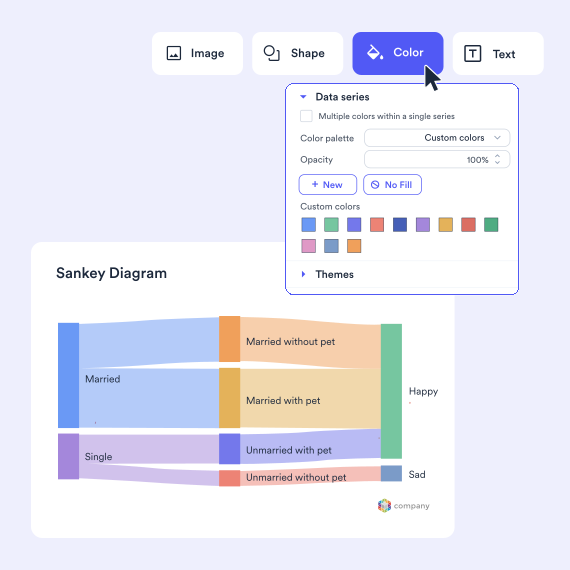
Illustration of Displayr Sankey diagram Customization

The simplest way to create and customize sankey diagrams

Create professional sankey diagrams free, online, no coding needed. Displayr’s sankey diagram generator lets you visualize flows, allocations, and customer journeys instantly. Export to PowerPoint, PDF, Excel, PNG/SVG, or publish as a live web page to share with your team.

And everything is customizable, including the color plalette, font, hover text, gaps and padding so it’s easy to make your Sankey diagram beautiful and branded.

Insightful, interactive, and flexible

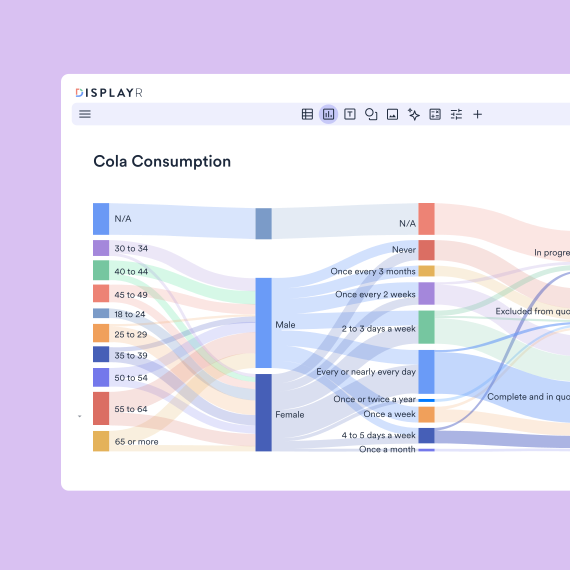
Displayr’s Sankey diagrams are flexible and can be used even if the variables don’t have a one-to-many relationship by setting link colours to variables. Add a filter to make your Sankey charts interactive and even more meaningful. Annotate your Sankey diagram with text boxes, arrows, and shapes to highlight exciting results, and insert background images and text to create a better data story.

Illustration of Displayr Interactive Sankey diagram
Illustration of Displayr Sankey diagram export options

Easily publish, embed, or export sankey diagrams to PowerPoint

With just one click, you can publish your Sankey diagrams as interactive dashboards with filter drop-downs and hovers. Or export to PowerPoint or PDF. And if you need to update or change your data, just switch the data and everything will update automatically on your Sankey diagram.

Don’t just stop at Sankey charts, Displayr is the complete tool for all your data analysis, visualization, and reporting.

Make your sankey diagram
in 3 easy steps

Create

Step 2

Follow the prompts to connect, type, or paste in your data and create your Sankey diagram. Here you can easily customize fonts, colors, backgrounds and sizes or do deeper analysis.

Results

Step 3

Publish your Sankey diagram as an interactive dashboard, then export it to PowerPoint or as a PDF with one click.

Graph chart - Visualizations

Sankey Diagram Use Cases

 
Sankey diagrams work for customer journeys, budget flows, survey data, supply chains, and more. Displayr handles complex scenarios where standard tools fall short.
 
Once you’ve created your sankey diagram, integrate it with your other research analysis in one platform — crosstabs, statistical tests, and more. Export to PowerPoint, PDF, Excel, or PNG/SVG without the copy-paste nightmare.

Create Sankey Diagrams Free, Online, No Coding Required

 
Build professional sankey diagrams without programming. Connect R data, import Excel,
or use the visual builder — no SQL or coding knowledge needed. Analyze, visualize,
and export to PowerPoint, PDF, or web in one platform.
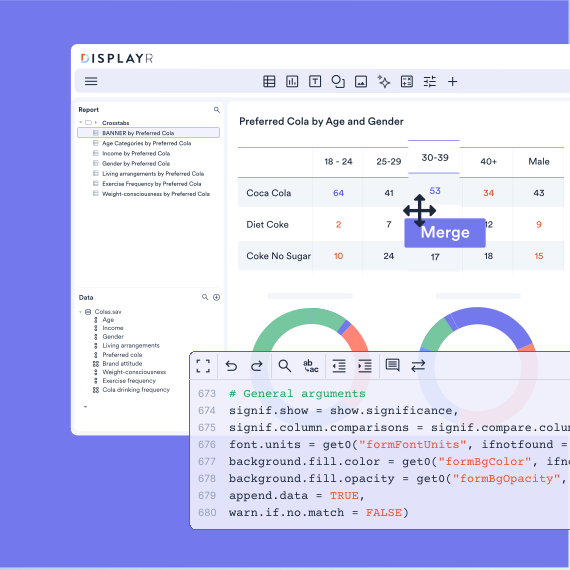
Displayr app screen showing Data App code

What is a sankey diagram?

Sankey diagrams (also known as Sankey plots, Sankey charts, or alluvial diagrams) are an awesome way of visualizing the flow of data, where the width of each flow is based on its quantity.

They are particularly well suited for displaying decision trees, and are often used in the visualization of material flow analysis.

Sankey diagrams assist greatly with locating the most important contributions to a flow. In addition, they frequently depict conserved quantities within defined system boundaries.

In scientific fields such as physics, Sankey diagrams are often used to represent energy inputs, useful output, and wasted output.

Sankey diagrams are made up of three sets of elements: the nodes, the links and the instructions which determine their positions.

Nodes are different groups or variables. For example, if your Sankey diagram represents a person’s monthly budget, the nodes may be the different categories for expenses.

Links are the lines that connect the nodes together, and their size in terms of thickness is determined by the values associated with them.

The instructions determine where the nodes appear in relation to each other. It sounds complicated but is actually pretty simple.

With Displayr’s Sankey diagram generator, your Sankey diagram can range from relatively simple to as complex as you like. You can customize your colors to flow from the first node or the last or by particular variables. In addition, you can change the size of the nodes and labels, and also change the positioning of the nodes and links by manually dragging and dropping.

How to create a Sankey diagram from Excel

Excel doesn’t have a built-in Sankey diagram chart type, but you can import your Excel data into Displayr and build one in a few clicks:
  1. Prepare your Excel file — one row per record, one variable per column, descriptive headers in the first row. (Full Excel setup guide here.)
  2. Import it into Displayr as a data set.
  3. Add a Sankey visualization — Visualization → Exotic → Sankey — then drag the variables you want to flow between onto it.
  4. Customize and export to PowerPoint, PDF, PNG, or publish as an interactive dashboard.
Displayr gets us out of PowerPoint and Excel and into a more advanced system where we all want to be. It almost makes the report building process more fun!
Dan Genord
Dan Genord

Director, Satrix Solutions

See why people love Displayr

Sankey diagram FAQs

When should I use a Sankey diagram?

Sankey diagrams are used to visualize the flow of resources. They portray sources and uses of the resources, materials, or costs represented. They are useful for communicating complex flows visually, with a concentration on a single aspect or resource that you wish to highlight. They are often used in energy management, fields of science, or manufacturing.

How do you read and interpret Sankey diagrams?

To effectively read and interpret a Sankey diagram, please note that the width of the lines and arrows is proportional to the quantity that is represented. This means that their width depicts the amounts or volumes of resources.

What type of data is displayed in a Sankey diagram?

A Sankey diagram is suitable for communicating data from complicated systems. Within a Sankey diagram, data can be analyzed to discover patterns, find bottlenecks, assist with troubleshooting, and help users understand how processes flow.

Can I create sankey diagrams in R?

Yes. Displayr integrates directly with R — import your R data, use Displayr's visual sankey diagram maker to build it, and optionally use R syntax for advanced customization. No coding required if you prefer the visual approach.

Why are they called Sankey diagrams?

Sankey diagrams are named after Matthew Henry Phineas Riall Sankey, an Irish-born engineer and captain in the Royal Engineers. In 1898, Sankey first used this type of visualization to show the energy efficiency of a steam engine.

How do I create a Sankey diagram in Displayr?

  • Click Visualization
  • Select Exotic
  • Select the Sankey
  • Click Add Data or Drag across your variable from Data Sets
  • Click OK
  • Customize the Sankey Diagram using the options in the right hand menu

Is this Sankey diagram generator free?

Yes, Displayr’s Sankey diagram maker is free, easy to use, and visually intuitive. It’s built for all skills, levels, and requirements. Start here.

Learn more about Sankey diagrams

Chat with us