



There are literally hundreds of different ways you could use AI in market research. It might be automatically categorizing text from surveys, generating executive summaries of studies, uploading synthetic samples into your data, or making AI-powered predictions on future trends.
In fact, if there’s a process in your workflow that’s taking a long time, chances are there’s a way you can automate it with AI.
What is AI market research?
AI in market research is all about speeding up existing workflows and creating entirely new ways of working. In the world of market research, advances in AI have brought many of the same efficiency improvements we’re seeing across industries. Faster report generation, fewer errors, and more time for high-value tasks.
Displayr’s data suggests that if the market research industry follows the standard diffusion of innovations theory, we can expect productivity gains of 100% over the next five years and 200% in 15 years.
The best AI market research tools at a glance
With so many different use cases of AI in market research, there are a host of different tools available for you to add to your tech stack.
15 AI market research tools compared
Choosing the right tool for you and your business is going to depend on a number of different factors – your goals, your AI strategy, your customers, and your available resources. To help you find the right solution we have pulled together this guide to explain what some of the industry leaders do and how it could benefit you.
Displayr
Displayr AI allows market researchers to perform powerful analysis and generate valuable insights with speed and accuracy. AI-powered text analytics enables users to instantly find themes and classify responses from open-ended text data, then perform advanced analysis and visualize the findings.
Displayr’s natural language interface serves as an in-built research assistant for market researchers, performing analysis, cleaning data, and enriching insights with the guidance of prompts. All quantitative analysis done in Displayr can also be easily checked and verified against the original data source, unlike other black box tools. This is because the best AI for market research software platform is something that produces results you can defend.
ChatGPT
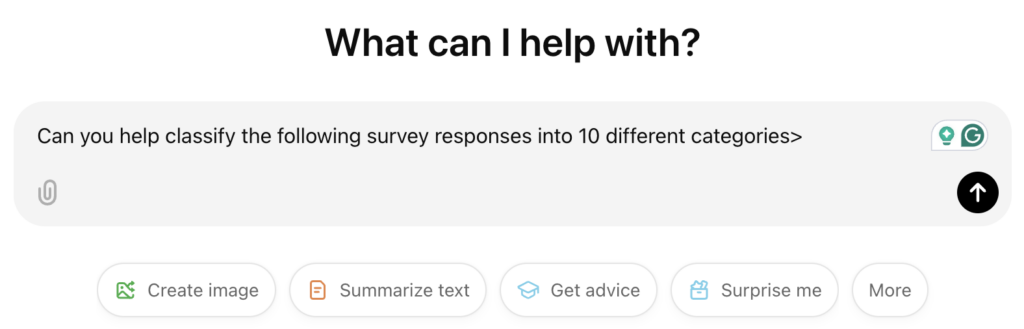
As mentioned above, budget is one of the main determining factors when selecting an AI tool for market researchers. Although ChatGPT offers paid plans with enhanced benefits, the free version is still a very useful tool for any market researcher, especially when used effectively. ChatGPT can easily write summaries of your reports, analyze text, conduct sentiment analysis or predict market trends. Be sure to brush up on your prompt-engineering skills before you get started.
Qualtrics
Qualtrics offers a number of different AI solutions that help market researchers to work smarter and faster. It analyzes more than 3.5 billion conversations each year in 20 different languages, meaning it has a vast database of human sentiment to work from. As a result, the company has embedded AI capabilities across its product suites that allow users to predict customer needs, anticipate and address employee attrition, improve customer experience, and share feedback.
BoltChatAI
BoltChatAI is an automated qualitative research platform designed to deliver qualitative research at scale. It allows users to utilize AI-generated discussion guides based on consumer conversations and conversational consumer chats to carry out qualitative research. After the research is carried out, results are shared within 24 hours.
Want to start automating your market research?
Book a demo of Displayr and we’ll show you.
Lucy
Lucy is an AI-powered knowledge management system designed to remove time-consuming processes of uploading, tagging, and curation while also ensuring new information and relevant updates are continually added to the system. This frees up time for team members and allows them to find answers easier.
Harmoni by Infotools
Harmoni by Infotools is a data-agnostic platform, designed to help market researchers process their data and generate insights. Use cases include; brand and advertising tracking, customer satisfaction, segmentation, usage, sales tracking, product testing and multi-level analysis and visualization.

Fairgen
Fairgen is a relative newcomer to the industry, launching in 2021. It offers AI solutions for the research, insights, and research technology industries. Researchers can use AI to generate insights decks and use synthetic sample boosters to improve the effective sample score of niche segments.
Quantilope
Founded in 2014, Quantilope has been designed to help market researchers automate consumer research. It has recently launched a number of AI tools and solutions, including automated survey creation and insight summaries, as well as an AI co-pilot to help improve productivity.
PRS IN VIVO
PRS IN VIVO is a research consultancy specializing in behavioral science and packaging. In 2021, it launched an AI solution to improve packaging effectiveness. The tool was designed to provide performance predictions for packaging design using an algorithm based on in-context behavioral data.
Blix
Blix provides a range of powerful features within its text analysis suite, including automatic topic identification, support for multiple languages, AI-driven coding, and the generation of automated summaries and reports. This makes it an excellent tool for professionals in market research, consumer insights, customer experience, and competitive intelligence.
Yabble
Yabble is known for its Virtual Audiences product, a synthetic data offering that allows researchers to generate insights without the traditional fieldwork stage. Virtual Audiences is based on Yabble’s augmented data model, which collects relevant and timely information based on a user’s topic of interest and synthesizes this data into a lake of knowledge.
NewtonX
NewtonX is a B2B research company, offering expert insights from business professionals spanning 140 industries. It has developed an AI-driven algorithm to help researchers find niche audiences at scale. The algorithm works by taking the research question, refining the audience, scanning professional networks, and then compiling a list of relevant professionals to speak with.
Canvs AI
Canvs AI offers tools for measuring emotions, analyzing topics and themes, and includes a generative AI assistant to help users. The platform allows users to customize their experience by adding, removing, or reclassifying emotions, topics, or codes. It’s an invaluable resource for those involved in brand research, consumer behavior analysis, or testing new concepts.
Vurvey
Vurvey is a generative AI-based web platform that enhances video surveys with AI to add scale to market research projects. It offers AI trained on customers’ unique data and industry knowledge. This provides on-demand access to consumer intelligence, helping researchers make better-informed decisions.
Claude Code
Claude Code is an AI agent from Anthropic that works in the terminal, a desktop app or an IDE, reading data files directly, running analysis, and connecting to tools like HubSpot, Google Search Console and Notion. This makes it useful for research teams who want to automate repetitive data preparation and reporting. However, it does mostly operate as a ‘blackbox’ meaning it is hard to see exactly how data has been analyzed.
Can you use AI for market research?
Although tools like ChatGPT, Claude and Displayr offer useful free versions, implementing AI into your market research is going to come with a price tag. So do you even need to use AI when conducting market research?
The short answer is no. Market research existed long before AI was the phenomenon it is today, and every step in your workflow could be done manually if required. But in a competitive market, the speed and productivity gains that AI brings can be exactly what you need to get the edge over your competitors.
Displayr’s (anecdotal) research has found that around 50% of market researchers are either using or experimenting with AI, while the other 50% are feeling anxious about it.
AI brings clear risks for market researchers, particularly around hallucinations and accuracy issues. However, these risks can be mitigated by human intervention (i.e., manually reviewing AI-generated outputs), and they do not outweigh the risk of being left behind.
Displayr AI lets you spend less time deciphering information and more time analyzing data. It’s a one-stop AI marketing research tool for text analysis, crosstabs, statistical testing, driver analysis and more.
Best AI market research tools at compared
| Tool | Best for | Pricing | What it doesn’t do |
| Displayr | End-to-end survey analysis and reporting — crosstabs, significance testing, text analytics and dashboards that update with new data | See pricing here. | Does not collect data or run fieldwork |
| ChatGPT | Summarizing documents, desk research and first-draft writing | Free + paid plans | No survey data model — no weighting, banner tables or significance testing |
| Claude Code | Automating data preparation and reporting workflows across files and connected tools | Included with Claude plans | No survey data model, and assumes comfort working with raw data files |
| Qualtrics | Enterprise experience management across multiple feedback channels | Quote on request | Heavy setup and cost for teams that only need analysis |
| Quantilope | Automated end-to-end consumer studies with advanced methods built in | Quote on request | Built around its own studies, so less suited to data collected elsewhere |
| Harmoni by Infotools | Processing and reporting tracker data — brand, advertising and customer satisfaction | Quote on request | Does not collect data |
| Blix | Coding open-ended responses and multi-language text analysis | Quote on request | Text only — no quantitative tabulation |
| Canvs AI | Measuring emotion, topics and themes in open-ended feedback | Quote on request | Text only — no crosstabs or statistical testing |
| Lucy | Finding answers across research you already own | Quote on request | Knowledge management, not analysis of raw survey data |
| Fairgen | Boosting effective sample size on small or niche segments | Quote on request | Augments a real sample rather than replacing fieldwork |
| Yabble | Synthetic audiences for fast answers without fieldwork | Quote on request | Does not analyze data you have collected yourself |
| BoltChatAI | Running qualitative research at scale with AI discussion guides | Quote on request | Qualitative only — no quantitative analysis |
| Vurvey | Video-based research at scale | Quote on request | Video and qualitative focus — no survey tabulation |
| NewtonX | Reaching niche B2B audiences across 140 industries | Quote on request | Sample and recruitment, not an analysis platform |
| PRS IN VIVO | Packaging effectiveness testing grounded in behavioral science | Quote on request | Specialist use case, not general survey analysis |
Frequently Asked Questions About AI Market Research Tools
Which AI tool is best for market research?
There is no single best tool, because market research covers several different jobs. For analyzing survey data — crosstabs, significance testing, weighting and reporting — a purpose-built platform like Displayr or Q is the right fit. For desk research and summarizing documents, a general model like ChatGPT or Claude works well. For coding open-ended responses, a dedicated text analysis tool such as Blix or Canvs AI will beat a general-purpose AI market research tool. Match the tool to the stage of the project rather than looking for one that does everything.
What are the top 5 AI marketing tools?
AI marketing tools and AI market research tools solve different problems, and the two lists rarely overlap. Marketing teams typically reach for ChatGPT for copy, Jasper for campaign content, HubSpot AI for CRM workflows, Brandwatch for social listening, and Similarweb for competitor traffic. Researchers need something different: tools that read survey data, run statistical tests and produce a defensible report. Everything on this page is built for the second job.
What are the best AI research tools?
It depends whether you mean primary research or desk research. For primary research — analyzing data you have collected yourself — look at Displayr, Quantilope and Qualtrics. For desk research and literature review, Perplexity and ChatGPT with web search are faster. For synthetic respondents and sample boosting, Yabble and Fairgen are the established options. The main mistake is using a general AI research tool for survey analysis, where it will struggle with multiple-response questions, weighting and significance testing.
Can I use AI for market research?
Yes, and most research teams already do. AI is reliable today for the repetitive stages: cleaning and preparing data, coding open-ended responses into themes, generating first-draft summaries, and building reports that refresh when new data arrives. It is less reliable for interpretation and for deciding what a finding means for the business, which still needs a researcher. The practical approach is to use AI for survey analysis to remove manual work, then review the output before it reaches a client.
How do I choose the right AI market research platform for my team?
Work backwards from the stage of the project that costs you the most time. Then check five things:
- Data handling: can it read SPSS, CSV and your survey platform’s exports directly?
- Analysis depth: does it run crosstabs with significance testing and weighting, or only summaries?
- Reporting: simple charts, or dashboards and decks that refresh when new data lands?
- Traceability: can you see where a number came from, so you can defend it to a client?
- Pricing: per project or per seat, and what happens as your data volume grows?
A general-purpose assistant will handle the first two stages of a project. An AI market research platform is what you need for the last two.
Can AI market research tools automate my entire research workflow?
Not the entire workflow, but more of it than most teams realize. AI reliably handles data import and cleaning, open-end coding, statistical testing, and report generation that updates when new waves arrive. What it does not do well is decide which questions matter, judge whether a finding is meaningful for the business, or catch the moment when the data is telling you something the model was not looking for. The teams getting most value automate the production work and keep a researcher on the interpretation.
How much do AI market research tools cost?
Pricing spans a wide range. General-purpose assistants start around $20 per user per month. Specialist AI market research platforms are usually quoted annually and depend on seats, data volume and whether dashboards are shared with clients. Free tiers exist for most general tools and for some specialist ones, though they normally cap data size or exports — Displayr’s plans and pricing shows how that works in practice. Ask what happens at renewal when your data volume grows, since that is where costs tend to move.