
The Trust Gap – a survey of 203 market researchers, fielded March 2026.
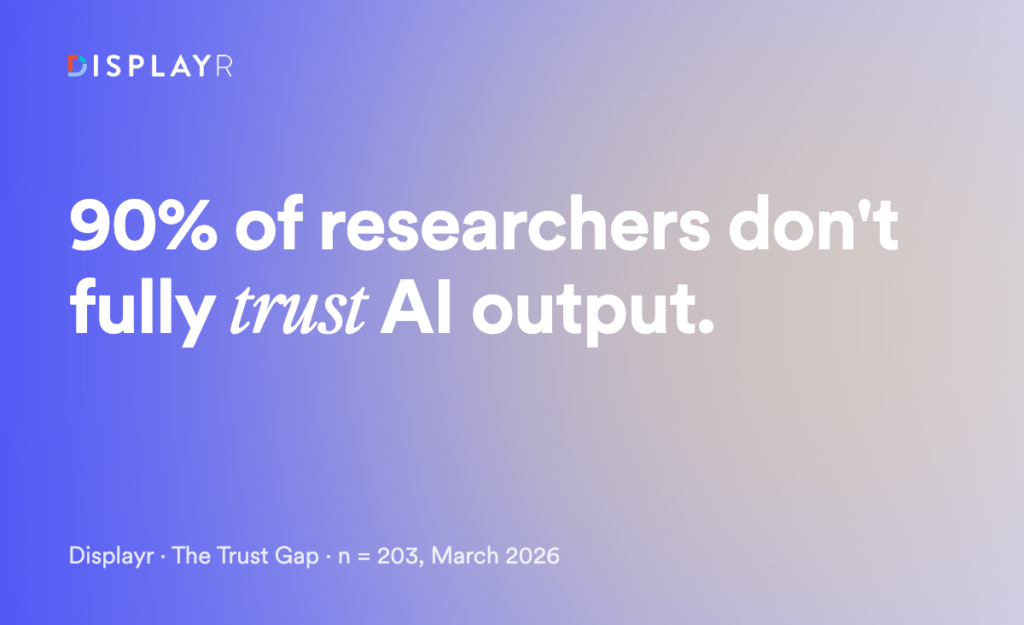
Almost every market researcher now uses AI, but almost none of them fully trusts it. In this study of 203 researchers, 90% said they are not fully confident in the accuracy of AI outputs, while just 5% use no AI at all. The barrier to deeper adoption is not capability, cost or training – it is that researchers cannot reliably verify what AI produces without checking it themselves.
Key findings
- 90% of market researchers are not fully confident in AI output accuracy. Only 10% (n = 21) call themselves very confident.
- Adoption is near-universal but rarely deep. Just 5% use no AI at all, yet only 8% say it has completely transformed their workflow.
- 71% are stuck in the middle – using AI across specific steps while the workflow stays fragmented. 18% are still exploring, 11% have embedded it fully.
- Trusting the outputs is the biggest day-to-day challenge, named by 42% (n = 86), ahead of connecting AI into the workflow at 37% (n = 75).
- 67% double-check every AI output as a matter of routine (n = 135); a further 20% say results feel outright inconsistent (n = 40).
- What researchers want most is “to save time while keeping control” – 35% (n = 72), ahead of end-to-end automation at 32% (n = 64).
- Given a workflow they could trust, 41% would spend the time uncovering insights (n = 83) rather than delivering faster or taking on more work.
- 72% describe their workflow as partly or completely fragmented, and 35% name fragmentation as their primary readiness barrier.
Source for all figures: Displayr, The Trust Gap, n = 203, March 2026.
How widely is AI used in market research?
AI use is close to universal. Only 5% of the researchers that we spoke to use no AI at all. But depth of use tells a different story from breadth.
AI readiness tier (n = 203)
| Tier | What it looks like | % | n |
|---|---|---|---|
| Exploring | Trialling AI on isolated tasks, not built into the rhythm of the work | 18% | 37 |
| Applying | Using AI across specific steps, but the workflow stays fragmented | 71% | 144 |
| Embedding | AI across the full workflow, outputs traceable to source and verifiable | 11% | 22 |
Only 8% say AI has completely transformed how they work.
The Applying tier is where AI looks productive but stops short of changing what the work fundamentally is. Researchers run individual steps through AI — coding, summarising, drafting — then re-verify by hand. Time saved at one step is spent again at the next.
That shape matters. Widespread shallow adoption, with high willingness and low transformation, is what a trust ceiling looks like in data. Tools are available and enthusiasm is high, but something stops the last step.
Do market researchers trust AI?
Mostly, no — and not out of scepticism about the technology.
“How confident are you in the accuracy of AI outputs?” (n = 203)
| Response | % | n |
|---|---|---|
| Somewhat confident — still double-checking everything | 67% | 135 |
| Not confident — results feel inconsistent | 20% | 40 |
| Very confident — easy to verify and reproduce | 10% | 21 |
| Unsure — unclear how the AI works | 3% | 7 |
90% of researchers are not fully confident in AI output accuracy — the 67% who double-check everything, the 20% who find results inconsistent, and the 3% who do not understand the method.
This is professional caution, not resistance. Researchers carry accuracy on behalf of clients and stakeholders, and when the reasoning behind an output is opaque, re-deriving it by hand is the rational response.
What is holding AI adoption back?
Not the barriers usually assumed.
“What is your biggest day-to-day challenge with AI?” (n = 203)
| Response | % | n |
|---|---|---|
| Trusting the outputs are correct | 42% | 86 |
| Connecting AI into the workflow | 37% | 75 |
| Understanding what AI can actually do | 13% | 26 |
| Getting buy-in from leadership or clients | 8% | 16 |
Capability and buy-in — the two explanations most often reached for — account for 21% between them. Trust and workflow fragmentation account for 79%.
Asked what blocks AI readiness overall, 63% point to trust. Fragmentation is the second barrier: 35% name it as their primary blocker, and 72% describe their workflow as partly or completely fragmented.
What do researchers actually want from AI?
“What do you want most from AI?” (n = 203)
| Response | % | n |
|---|---|---|
| To save time while keeping control | 35% | 72 |
| To automate repetitive steps end-to-end | 32% | 64 |
| To generate new insights I couldn’t see before | 23% | 47 |
| To reduce human error and rework | 10% | 20 |
The most common answer carries its own qualifier: while keeping control. Researchers are not asking for less automation. They are asking for automation they can supervise, interrogate and stand behind professionally.
What would change if AI were trustworthy?
“A trustworthy AI workflow would enable me to…” (n = 203)
| Response | % | n |
|---|---|---|
| Spend more time uncovering insights | 41% | 83 |
| Deliver results faster to stakeholders | 30% | 61 |
| Take on more projects with the same team | 21% | 42 |
| Stop redoing the same work every week | 8% | 17 |
The largest group would put recovered time into insight rather than throughput. Trust is not only a barrier to efficiency — it is the precondition for deeper strategic work.
What closing the trust gap requires
Three conditions emerge from the confidence, aspiration and workflow data combined. None is sufficient on its own.
- Verifiability — outputs that can be checked against source data and reproduced consistently. With 67% double-checking as routine, the answer is not to ask for more trust but to supply better grounds for it.
- Transparency — being able to follow the analytical logic behind a result. Only 3% say outright that they do not understand how the AI works, but much of the somewhat-confident tier is managing methodological uncertainty by adding manual checks.
- Workflow continuity — AI embedded in the process rather than bolted onto it. With 72% reporting fragmented workflows, trustworthy AI in the wrong place still does not help.
Which tier is your team in?
A short self-assessment using the same three tiers as the study. Answer for how your team works in a typical week, not at its best.
| Ask yourself | Exploring | Applying | Embedding |
|---|---|---|---|
| How often is AI used? | Occasional, task by task | Regularly, at specific steps | Continuously, across the process |
| Can outputs be traced to source data? | Rarely | Sometimes, manually | Yes, by design |
| What happens after AI produces a result? | It is redone by hand | It is checked by hand | It is spot-checked on a schedule |
| Can an analysis be re-run from source? | No | Partly | Yes, on demand |
| Where does saved time go? | Nowhere — it is spent verifying | Partly recovered | Into interpretation |
Three or more answers in the middle column puts you with the 71% majority. That is the tier where the trust gap costs most, because the workflow has changed but the accountability burden has not.
Frequently asked questions
What percentage of market researchers use AI?
95% of the 203 researchers surveyed use AI to some degree — only 5% use none at all. However, just 8% say it has completely transformed their workflow, and only 11% have embedded it across the full research process.
Do market researchers trust AI outputs?
90% are not fully confident in AI output accuracy. 67% double-check every output as a matter of routine, 20% find results inconsistent, and 3% do not understand how the AI works. Only 10% describe themselves as very confident.
What is the biggest barrier to AI adoption in market research?
Trust. 42% name trusting the outputs as their biggest day-to-day challenge and 63% cite trust as their primary readiness blocker. Understanding what AI can do (13%) and getting leadership buy-in (8%) are far smaller obstacles.
Will AI replace market researchers?
The study does not support that reading. Adoption is near-universal, but only 8% report a transformed workflow and the top request is to save time while keeping control (35%). Researchers are seeking supervised automation, not autonomy.
How was this study conducted?
203 market researchers were surveyed through the Displayr AI Readiness Quiz in March 2026. Percentages are of total respondents and base sizes are published against every figure.
The gap is closing, but not by itself
The researchers in this study are not sceptics. They apply to AI exactly the standards that make good research good: can I check this, can I reproduce it, can I stand behind it in front of a client? On current evidence, most AI workflows cannot yet answer yes.
That is a solvable problem, and the prize is specific. 41% of researchers say a workflow they could trust would buy them time for insight rather than throughput. The teams that get there first will not simply produce reports faster — they will be doing different work.
Displayr automates the production layer of survey analysis — coding open ends, crosstabs and significance testing, weighting, and the reporting built on them — with outputs that trace back to source data and can be re-run on demand.
Cite this study
Full designed report: The Trust Gap whitepaper.