


Learn More about Conjoint in Displayr

Introduction Conjoint Analysis: The Basics Main Applications of Conjoint Analysis Webinar: Introduction to Conjoint Design Experimental Design for Conjoint Analysis: Overview and Examples Writing a Questionnaire for a Conjoint Analysis Study Sample Size for Conjoint Analysis Algorithms to Create your Choice Model Experimental Design The Efficient Algorithm for Choice Model Experimental Designs The Partial […]
Using Choice-Based Conjoint in Pricing Research Studies
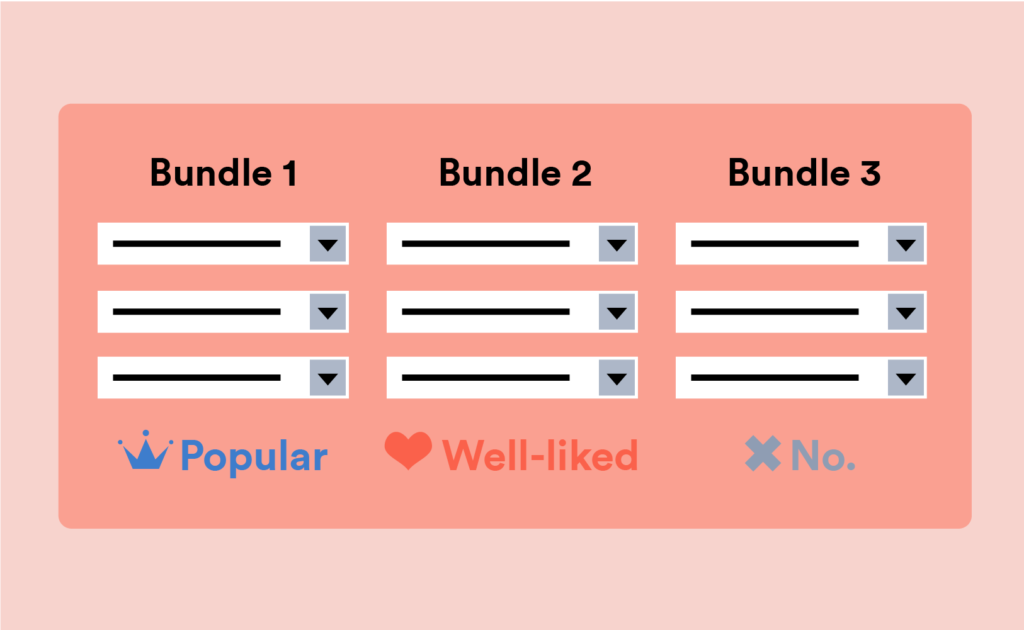
This one is a bit more complicated than the first five techniques we’ve talked about, but the idea of this technique is to find people’s preferences by providing them tradeoffs between a series of products and describing them based on certain attributes. For example, below is a question that compares several different cell phone providers […]
Using the Value Equivalence Line (VEL) with Conjoint Simulators
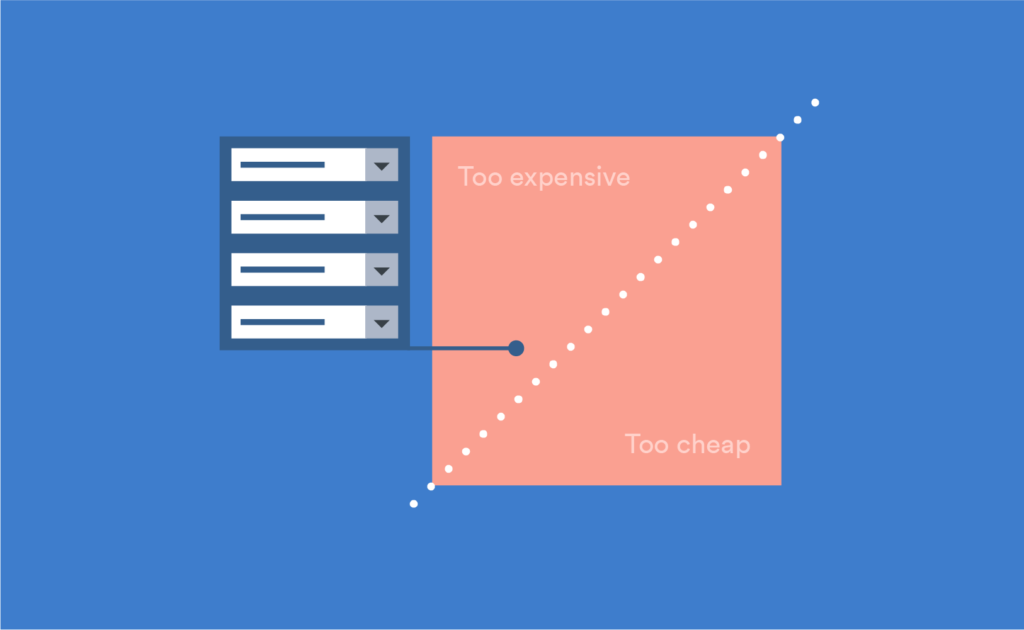
The value equivalence line is a useful concept for setting pricing strategies in markets where products vary in terms of their overall levels of benefits (e.g., quality levels). This post explains how the value equivalence line can be used in conjunction with a conjoint simulator to portfolios, illustrated using a study of the US cell […]
Comparing HB Root-likelihood (RLH) Between Displayr and Sawtooth
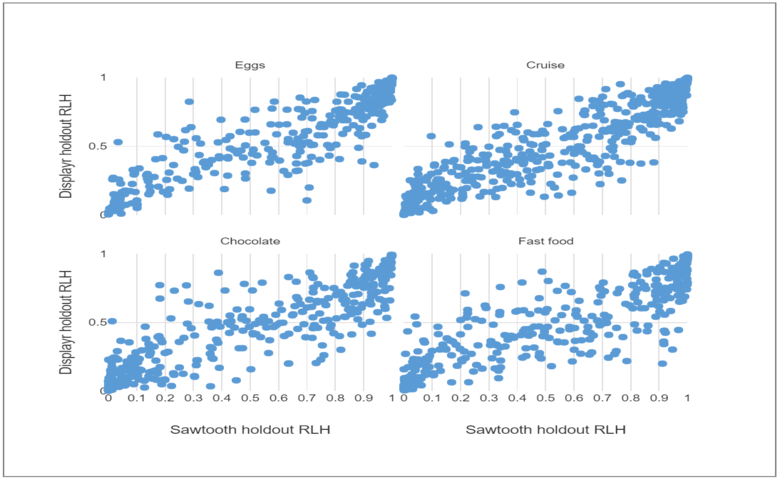
Root-likelihood (RLH) is a way to measure how well a choice model fits a data set. The RLH is a value ranging between 0 and 1, where a higher value indicates a better fit. It is less susceptible to noise than prediction accuracy but is less commonly used, perhaps because it is harder to conceptualize […]
Testing Whether an Attribute Should be Numeric or Categorical in Conjoint Analysis
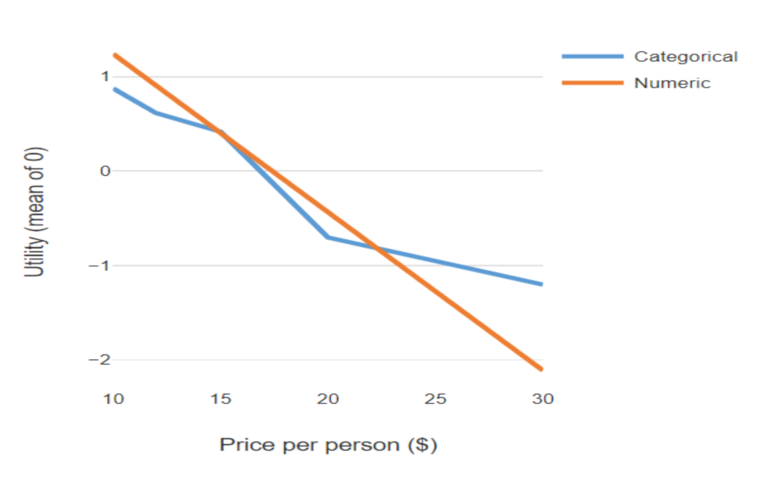
Most choice-based conjoint (CBC) studies in marketing specify a fixed number of levels for each attribute. For example, a study of the fast food market could test a variety of prices — $10, $12, $15, $20, and $30 — and estimate the utility (or appeal) of each price point. However, in Economics it is more […]
Understanding Logit Scaling

Example: choice-based conjoint analysis utilities Consider the utilities plot below, which quantifies the appeal of different aspects of home delivery. If you hover over the mouse plot you will see the utilities. For example, you can see that Mexican has a utility of 4.6 and Indian of 0. These values are logit scaled. Converting logit-scaled values into […]
Numeric versus Categorical Price Attributes in Conjoint Analysis
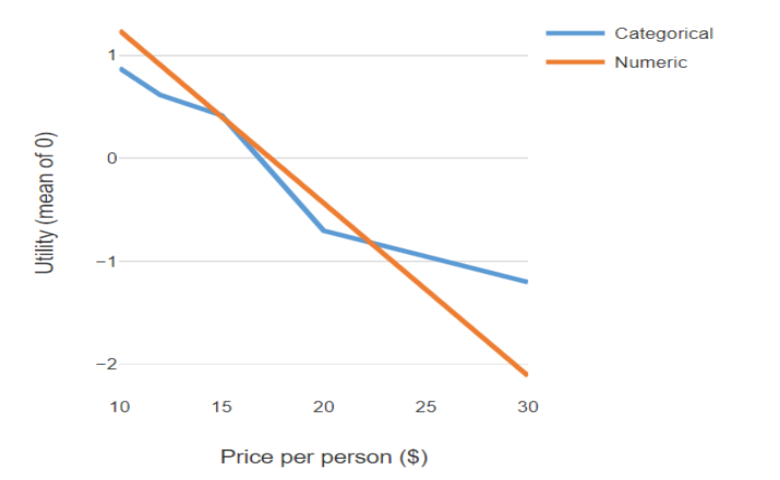
The difference between a numeric and categorical price attribute The chart below illustrates the the implications of treating price as being categorical versus numeric. When price is treated as a numeric attribute (variable), the model assumes that there is a linear relationship between price and utility, as shown by the orange line. When price is […]
Checking Convergence When Using Hierarchical Bayes for Conjoint Analysis
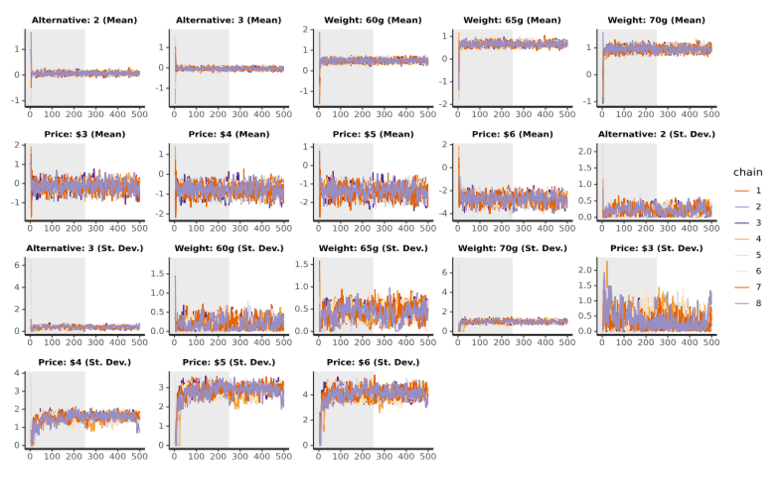
Please read How to Use Hierarchical Bayes for Choice Modeling in Displayr prior to reading this post. There are a number of diagnostic tools that you can use to check the convergence of the model. These include looking at the statistics of the parameter estimates themselves, checking trace plots which describe the evolution of the estimates […]
12 Techniques for Increasing the Accuracy of Forecasts from Conjoint Analysis

So, how accurate are choice experiments? Clients of choice experiments often request statements regarding the predictive accuracy of the technique. Unfortunately, only crooks provide such assurances. While many thousands of choice experiments have been conducted, the accuracy of only a handful have ever been published. This tells us two things: it is hard to assess […]
Data Visualization for Conjoint Analysis
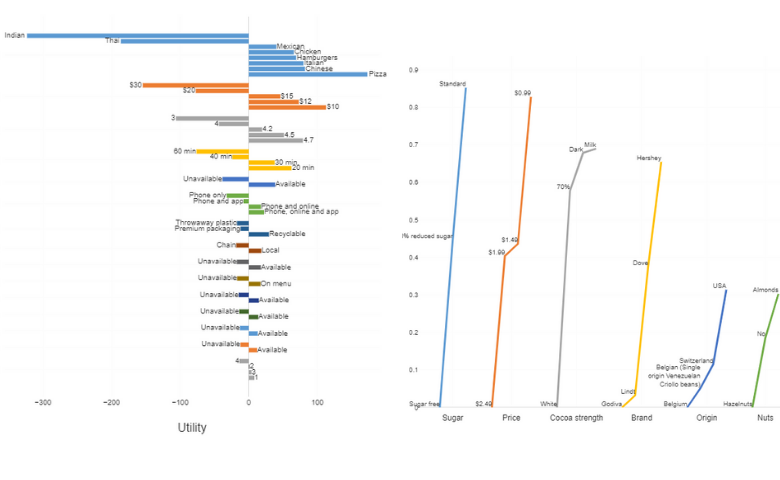
While choice-based conjoint analysis represents one of the more sophisticated techniques used in market research, presentation of its results commonly consists only of a simulator, and a few pie or bar charts. This leaves its users with only a limited understanding of the key patterns in the data. In this post I show key data […]
Using Substitution Maps to Understand Preferences in Conjoint Analysis

Modern tools for analyzing conjoint analysis, such as hierarchical Bayes, produce rich data showing preferences for each person in a market. The main deliverable from such research is a choice simulator. A practical challenge with choice simulators is that while they can answer any specific question, it is often hard to extract detailed insight from […]
Using Indifference Curves to Understand Tradeoffs in Conjoint Analysis
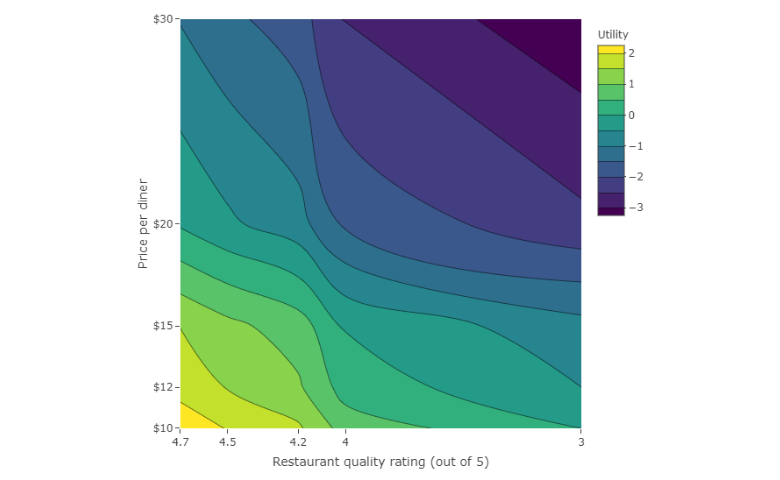
Indifference curves are a way of showing relative preferences for quantities of two things (e.g., preferences for price versus delivery times for fast food). This post shows how to compute indifference curves for conjoint analysis models. Example The contour plot below shows indifference between price and meal quality, from a choice-based conjoint study of home delivery preferences […]
Sample Size for Conjoint Analysis

Working out the sample size required for a choice-based conjoint study is a mixture of art and science. What makes it tricky is that the required sample size depends on a number of different things: The experimental design. The more alternatives in a question, the smaller the sample size that is needed. The more levels […]
Writing a Questionnaire for a Conjoint Analysis Study

The Screener The first section of a questionnaire generally contains the screening questions. These questions are used to determine if people are eligible for the study (e.g., are users of a particular product). They are used as well for collating quota information (i.e., ensuring an adequate cross-section of people in key sub-groups). For example, surveys […]
Main Applications of Conjoint Analysis
If you haven’t yet, check out “Conjoint Analysis: the Basics” for a primer on Choice-Based-Conjoint Analysis. Testing the appeal of a new product Choice-based conjoint analysis is widely used for testing the appeal of a new products and services. For example, a new flavor of soft drink, a new cabin in an aircraft (premium economy), […]
Conjoint Analysis: The Basics

Typical examples include: cost benefit analysis for planning new transportation options (e.g., new train lines), designing new cabins on airplanes (e.g., legroom, beverage, in-flight entertainment), creating new breakfast cereals, etc. (see Main Applications of Conjoint Analysis for more info). Choice-based conjoint analysis has lots of other names, and is variously known as choice modeling, stated […]
Comparing Choice Models and Creating Ensembles in Displayr

There are a variety of different models available in Displayr to perform Choice Modeling. In fact, Displayr is the best choice modeling software in world. And did we mention it is free? You can read about “How to do Choice Modeling in Displayr” here! In this post we firstly describe how to easily compare the […]
The Efficient Algorithm for Choice Model Experimental Designs

In this blog post, I describe the Efficient algorithm for generating choice model designs. The Efficient algorithm is actually a special case of the more general Partial Profiles algorithm. This algorithm is used for generating choice model designs with partial profiles, with no constant attributes specified. In another blog post, I found that the Efficient algorithm also performs better […]
The Partial Profiles Algorithm for Experimental Designs
In this blog post, I shall describe the Partial Profiles algorithm for generating choice model designs, which is described in a recent research paper (listed in the references). The paper finds that this algorithm outperforms other algorithms when their designs are benchmarked by the D-error metric. The Efficient algorithm is a special case of the Partial Profiles algorithm where no constant attributes are […]
Comparing Experimental Designs Based on Model Fit
There are many ways to generate an experimental design. Perhaps the simplest is to randomly assign levels to alternatives in a design. However, other methods of generating designs exist which result in more balanced designs and designs with a lower D-error. Rather than assess the quality of a design based on design metrics, in this post […]
How to Compute D-Error for a Sawtooth Software CBC Experiment

In other articles I provide the mathematical definitions of D-error and worked examples of how to calculate D-error; but in the real world, most people will use existing tools to compute D-error. In this article I describe how to use Q and Displayr to compute the D-error for a design from a Sawtooth Software CBC […]
Algorithms to Create your Choice Model Experimental Design

Example of Choice Experiment In this post I am going to use an example of a choice experiment about chocolate bars. I’ve shown a sample question below. Let’s establish some terminology for describing choice experiments: Each question (also known as a task) shows the same number of alternatives. In the example, there are 4 alternatives. Each alternative consists of the […]
How to Set Up a Choice-Based Conjoint Analysis in Qualtrics

An example question appears below. Creating the choice experiment We can create a choice experiment in Displayr by selecting Insert > More > Conjoint/Choice Modeling > Experimental Design from the Ribbon. In Q, you select Automate > Browse Online Library > Conjoint/Choice Modeling > Experimental Design. It’s typically impossible to ask all combinations of […]
How to Compute D-error for a Choice Experiment

This article gives an overview of D-error and demonstrates how to compute D-error by working through an example. Concepts in this article are covered in more (mathematical) detail here. Prior parameter assumptions When computing D-error, a prior assumption about the respondent parameters needs to be made. D0-error assumes that all parameters are zero — i.e., […]
The Accuracy of Hierarchical Bayes When the Data Contains Segments

A simulation involving two segments To explore this problem I generated some simulated data for 200 fake respondents. I used a MaxDiff experiment with 10 alternatives (A, B, …, J) and 2 segments (75% and 25% in size). One segment was created to prefer the alternatives in order of A > B > … > […]
How Good is your Choice Model Experimental Design?

Defining Balance and Overlap Often, the quality of a design is described in terms of its balance and overlap. Balance is a measure of consistency of the frequencies of the attribute levels. Overlap is a measure of repetition of attribute levels within the same question. However, the drawback of these measures is that they produce […]
How to Create an Online Choice Simulator by Hand
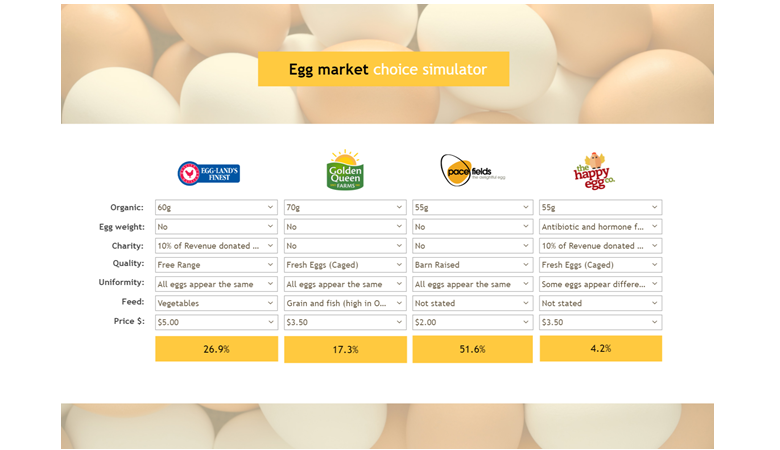
The seven steps to create an online choice simulator are detailed in the post. In addition, an interactive example of a choice simulator is provided along with a tool to create your own choice simulator. The calculations for the choice simulator example are done using R, and the simulator is hosted in Displayr – which is […]
How to Check an Experimental Design (MaxDiff, Choice Modeling)

In this post, I explain the basic process that I tend to follow when doing a rough-and-ready check of an experimental design. The last step, Checking with a small sample, is the gold-standard. I’ve never heard a good excuse for not doing this. Every now and then somebody sends me an experimental design and says, “Can […]